Ron Normandeau

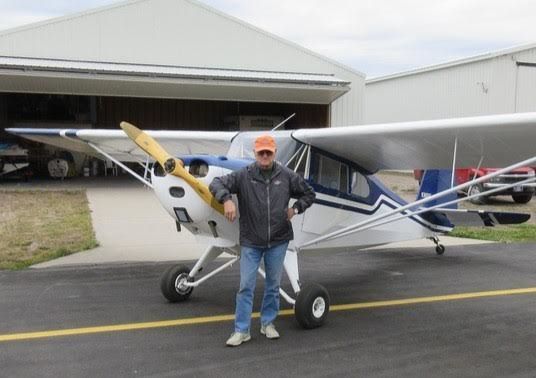
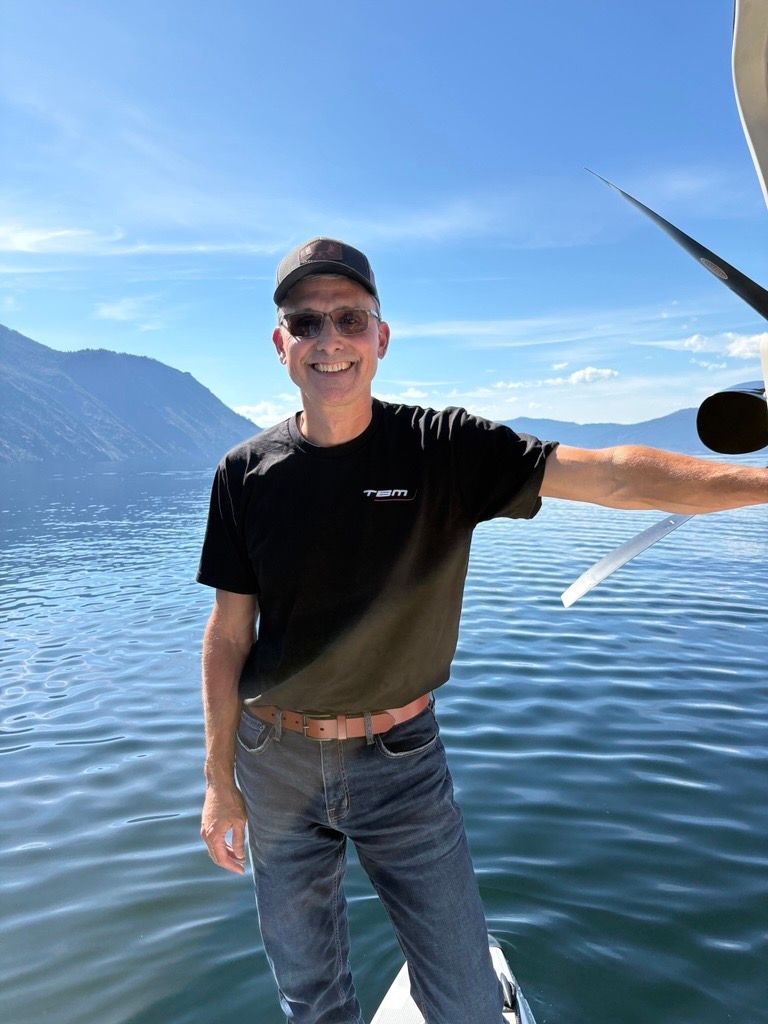
It’s hard to believe that Ron Normandeau’s aircraft started out as a box of airplane parts. Ron, of Polson, Montana built a beautiful 1947 Aeronca Chief and now enjoys flying his own plane. He began flying in 1962 between junior and senior high school years, and earned his license. Ron’s wife Kathi earned her private license shortly after high school, as well, learning from her father who was an instructor. They made an interesting couple, flying together in their early years together.


Their son Brett joined the Marine Corps on graduation from high school and was an airframe mechanic on the Harrier jump jet for his five-year tour. During college, Brett joined the Montana Army Air Guard. He earned his ATP and flew for Envoy Air (American Airlines’ largest regional) for a few years before flying Blackhawks full-time for the Guard. “I always supported Brett’s desire to participate in aviation,” Ron says. “Last summer he got his tailwheel endorsement in my Aeronca.”


Ron’s 32-year military career includes a year-and-a-half as combat engineer, Special Forces. He was assigned to the National Guard as an active duty advisor to Company C 19th Special Forces, reenlisted, and attended State OCS and was an A-team commander for two years. In the Reserves he spent 16 years evaluating guard and reserve units for readiness; and nine years as executive officer and commander of an Engineer Battalion.


A cup of coffee at Polson Airport led to Ron’s involvement in the RAF in 2004. He met RAF co-founder Chuck Jarecki, who took him along to RAF organizational meetings, work parties, and meetings with public agencies. In 2005 the RAF recruited Ron for its Montana State Liaison, one of the earliest to wear the signature orange shirt. 


Ron brings vast skills to the RAF, having majored in Forest Engineering, specializing in Photogrammetry/Cartography. While in college he was a smokejumper, Forest Service Indian liaison officer and forestry technician. On graduation, he joined the US Geological Survey, doing field surveys. He spent two years in Washington, DC in top secret work; then transferred to Denver’s Cartography division where he participated in the transition from manual to digital mapping. He wrapped up his lengthy career with the US Forest Service as Cartography/Photogrammetry supervisor.


“Eventually, I found myself doing more consulting with other RAF Liaisons on public agency matters. I discussed this with RAF President Bill McGlynn and he suggested I become the RAF Public Agency Consultant. I handle calls for guidance almost every week,” Ron says. And other RAF Liaisons are grateful for his experience and help.


“I hope to participate in a new program the Forest Service has initiated called ‘Re-imagine Recreation.’ The object is to create a plan for recreation, addressing the great numbers of visitors to the National Forests, and the change in recreational emphasis,” he says. His pursuit of the RAF mission will be part of Ron’s approach.


Ron has another passion. Golf – but with a cartographer’s passion. “My one other consuming interest is golf course measurement,” Ron says, explaining his intent. “Establishing a difficulty rating for the golf course. In conjunction with an individual’s handicap, it would allow fair competition between players of different skill levels.”


Submitted on May 12, 2023.

Recent Posts
By Kodi Myhre December 23, 2025
At about this time, every year, we have this conversation at the RAF about what our year end letter (code for asking for your financial support) should say to you, and about the RAF and the accomplishments of the past year.
By Taylin Trafton December 23, 2025
Our many RAF supporters have such vast and varied experience, and we’re capturing some of their words of wisdom to share with you. This guest editorial is by Stef Goza, a pilot and an RAF Alaska liaison.
By lellington December 21, 2025
Bill credits aviation for much of his success in business and the ability to serve his companies and family. What began in a Champ, and a Tri-Pacer owned by five people, turned into what Bill calls, “a key business tool” in which he accumulated 9,000 hours – in a Cheyenne, a Pilatus, and a TBM, where ninety-five percent of his flying was for business. “My retirement enabled me to recall ‘Why I Learned to Fly’, a slogan from an old RAF video.” Bill’s son, Patrick, purchased the C185 they now share. “While attending a business function, some associates arrived in corporate jets. As they joined up on the tarmac, the jet pilots gathered around Patrick’s 185, and one of the passengers asked, ‘What’s special about this?’ No explanation needed for this RAF audience,” Bill says. “My involvement in the RAF is, in a partial way, repaying the rewards aviation has endowed me with. Having been involved in many worthwhile nonprofits, this is one where financial support is only part of the picture. Physically participating in great projects that have a lasting effect, with good people, returns a great personal benefit,” he says. “My only regret is that I wasn’t there at the start.” Bill and his wife Jane are privileged to be able to split time between their long-time home in eastern Nebraska and Scottsdale, Arizona. While still serving on several boards, he enjoys golf “about every third shot,” biking, cars, and reading, but always looks forward to the time he can be involved in the RAF. “It’s flying with a purpose,” he adds. Bill can be reached at bdugan@theraf.org
December 15, 2025
AR Ambassador
By Taylin Trafton December 11, 2025
A Christmas gift of flight lessons from his parents started Scott Anttila’s aviation journey in 1985. “I learned at Johnson Field, a small grass strip tucked into the woods in Michigan’s Upper Peninsula, and that early exposure to simple backcountry flying stuck with me,” Scott says. Growing up in the U.P., he spent a lot of time outdoors and found that flying was another way to get to the places he liked to explore—especially the ones most people never saw. As he earned more ratings and eventually moved to the Detroit area for work, Scott realized he needed a way to stay connected to northern Michigan. He bought an airplane and used it to get back to the smaller airstrips and lake country he enjoyed. Along the way, he also flew gliders out of Frankfort, soaring along the Sleeping Bear Dunes and towing sailplanes over the Great Lakes. “Those flights gave me a different appreciation for the landscape and made me even more interested in the small, out-of-the-way airports scattered around the state,” he says. Visiting those kinds of places, Scott first came across the Recreational Aviation Foundation. He started using RAF-supported airstrips both inside and outside Michigan. “I noticed how well-kept they were and how much access they opened up,” he says, adding, ”Over the years, I’ve watched a number of grass strips close, which made the RAF’s mission feel especially important to me. Maintaining these airstrips keeps aviation connected to the outdoors and makes it possible for more people to reach the quiet, remote areas that inspired me to fly in the first place.” Scott joins the other two RAF Michigan Liaisons, General Grant and Tanmoy Ganguly. He can be reached at santtila@theraf.org . Submitted December 11, 2025.