RAF PARTNERS WITH TREAD LIGHTLY ON BACKCOUNTRY ETIQUETTE
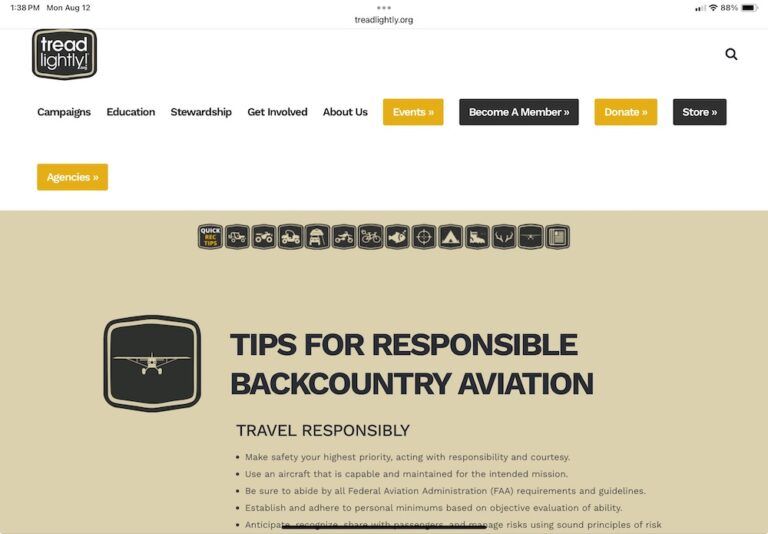
During the RAF’s biennial educational conference in Bozeman in May, the RAF debuted its Backcountry Etiquette Team and announced its partnership with Tread Lightly!, the national organization started in 1985 by the US Forest Service to address off-road usage. The organization became a nonprofit in 1990, and since then has garnered hundreds of partners from federal and state agencies, industry leaders such as Jeep, Nissan, Kawasaki, and Firestone, and recreational user groups, too numerous to mention. Like the RAF, all share the goal to preserve recreation access and opportunity by promoting ethics of good stewardship.
“Our intentions align perfectly,” RAF President Bill McGlynn said, adding, “And we are proud to be the vanguard aviation organization included as ‘partner’.”
Executive Director Matt Gaskins was equally pleased to loop in the RAF, and add the aviation component of recreational access. “I love what you’re doing with your campaign. It’s all about keeping these recreational assets sustainable in the future. The best way is doing our part to minimize our impact,” he said, adding, “We are very excited to help with the commendable mission you have. The industry needs this element.”
While Gaskins’ career path includes mostly corporate finance, he loves to share his passion for sustainable outdoor recreation and teach responsible 4×4 techniques. After working for Rivian in treasury and special projects, he spent time with Rivian Clubs of America, Lexus, and Land Rover as an advisor, consultant, and instructor.
He had an epiphany about two decades ago in the alpine tundra of Colorado where the growing season is short. “When damage is created, even a simple footprint or tire track, it may take decades or centuries to recover. Around Moab, some of the cryptobiotic soils took hundreds of years to develop. Step or drive on them, they are likely to die. Wind, snow, and rain accelerate erosion; more erosion can lead to trail closure.”
Gaskins shared his observations on the explosion of social media. “We’ve gone from a journalism model where media was mostly controlled by a few large corporations to a time where anyone with a smartphone has become a de facto journalist”. He agreed there is a strong “watch me” element driving the speed of dissemination, making it hard to control the narrative. “One strategy we have tried is to work with influencers to help us with our message. Social media rewards things that drive engagement. So if you share content that’s educational and inspiring like – How do I improve my experience while protecting the environment – it’s a winning combination.”
To accomplish this goal, Tread Lightly embarked on a massive education campaign of stewardship projects, signage at trailheads, online and in-person courses. Tread Lightly’s 2023 annual Impact Report states that 641 educational signs were installed at trailheads; and their volunteers removed over 241,000 pounds of trash from public lands that year alone.
One simple example Matt suggested to minimize impact is lowering air pressure in tires prior to off highway use. It spreads the impact and creates less trail or road damage. While aircraft don’t use driving wheels, shifting airstrip cones from side to side every year or so will disperse aircraft tire impact, and conserve the runway surface. See Tread Lightly’s website for much more information.
“We received a lot of great feedback when we announced our new partnership with Tread Lightly, and agree with Matt that education is better than enforcement or regulation,” RAF Backcountry Etiquette Team Chair Lynn Mareth said. “Our team has been working on the new messaging campaign, so watch for new signage,” she added.
“We are more effective when people of similar values connect. It magnifies our impact. When I listen to new viewpoints, I always learn and find things we can use in our toolkit to become more effective with our message. We definitely are stronger together,” Gaskins added.
By Carmine Mowbray
Posted August 15, 2024
Posted in News
Recent Posts