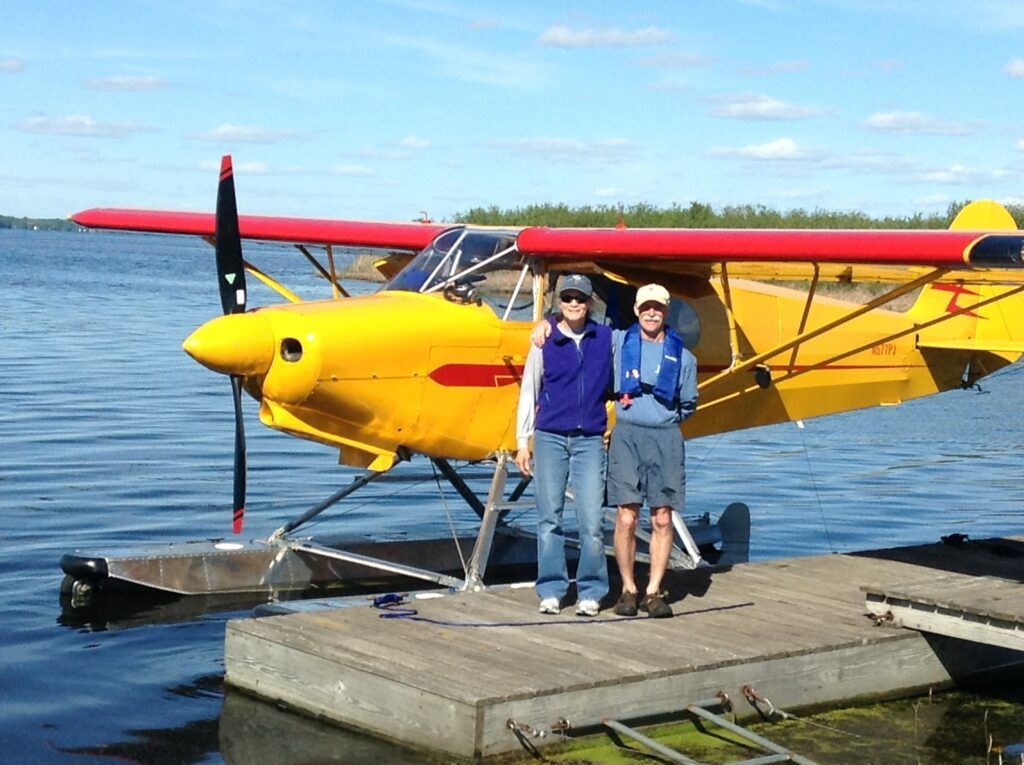
RAF FEATURED SUPPORTERS: JEFF AND PATTI PLANTZ
Some hundred years after the event at Kitty Hawk, two Wisconsin brothers calling themselves the “Wrong Brothers” built their own ultralight, and like Wilbur and Orville, attempted to teach themselves to fly. At least the more recent sibling duo had the advantage of a book on flying techniques.


“We’re still here,” says Jeff Plantz, one of the Wisconsin brothers. But the bug had also affected their father, and when he was age 60, they bought a Cessna 172 – that remains in the family, in addition to his brother’s Cherokee, and Bellanca Cruiser. Jeff and his wife Patti earned their private ratings. 


When Jeff and Patti decided to try some float flying, “We learned we couldn’t rent a seaplane, so we built one,” Jeff says. He met RAF Director Jeff Russell who had a Cub across his home airport at Madison and was impressed with it. Beginning with a Piper PA-14 Family Cruiser, they assembled a side-by-side Cub on amphibious floats with plenty of baggage room for their many cross-country adventures – the payoff for those ten years it took to assemble the aircraft.


Patti and Jeff have a unique appetite for adventure. After college, he had his own counseling practice. But “the urge for goin’ ” affected both Jeff and Patti, and they became what he calls “bed buggers,” or long-distance truckers. They bought a semi tractor, with a custom-designed cab and sleeper with the amenities they wanted, especially considering they brought their young child on their trips. “We’d work hard for two weeks, get rid of the trailer, then camp at National Parks, or stay with relatives from Seattle, or Colorado, Florida, to Vermont.” Following that enterprise, they operated a jewelry business, repairing watches and clocks while their kids grew up. Jeff went back to driving, and took a Fed EX route while Patti provided accounting services. “Patti is a heck of a trooper. She’s a great taildragger and floatplane pilot. We’ve been together nearly 50 years, and she tolerates stuff like when I alerted her of a huge credit card charge for those amphibious floats,” he said.


Jeff’s social conscience led him to a job with Head Start, and among all these engagements, he and Patti have fit in many flights throughout the country. After ten years of flying the Cub on floats, they’ve exchanged them for wheels. Close to home they’ve helped out at Gillette’s Lakewood Lodge, Cornucopia, and have ventured much farther through Montana and Idaho, enjoying camping in the Missouri Breaks, Ryan Field, and Johnson Creek. “You usually run into very nice people,” Jeff says. This autumn, the fall colors sparked their wanderlust, and they drove their RV to Nova Scotia. So if you do catch a glimpse of this interesting pair of travelers, be sure to thank them for their support of the RAF.


Submitted Oct 14, 2024
By Carmine Mowbray

Recent Posts
March 25, 2026
Many people are familiar with Qualified Charitable Distributions (QCDs), which allow IRA dollars to go directly to charity tax-free — but QCDs are only available starting at age 70 1⁄2. If you’re between the ages of 59 1⁄2 and 70 1⁄2 and charitably inclined, there are still several effective ways to use IRA dollars strategically. Why Plan Charitable Giving from an IRA? Strategic Planning can help: Offset taxable income Reduce long-term RMD exposure Improve tax efficiency for heirs Align giving with long-term legacy goals Strategies to Plan Charitable Giving from an IRA IRA Distribution + Charitable Deduction: Take a taxable IRA withdrawal and make a charitable gift. If you itemize, the deduction may offset some or all of the taxable income. Best for clients who already itemize and have large charitable intent. Donor-Advised Fund (DAF): Take a larger IRA distribution in one year and contribute it to a Donor-Advised Fund. This allows you to bunch deductions into one tax year while distributing to charities over time. Best for higher-income earners and tax planning years. Roth Conversion + Charitable Offset: Convert IRA dollars to Roth and use charitable deductions to offset some of the taxable income. This may reduce future RMDs and create tax-free growth. Best during early retirement or lower tax bracket years. Best for larger IRA balances and legacy-focused planning. Charitable Remainder Trust (CRT): Use IRA distributions to fund a trust that provides income to you for life, offers an immediate charitable deduction, and leaves the remainder to charity. Leave IRA to Charity at Death: IRA assets are taxable to heirs but not to charities. Naming a charity as an IRA beneficiary can be one of the most tax-efficient estate planning strategies. Side-by-Side Strategy Comparison:
By Carmine Mowbray March 24, 2026
Pamela Cox is a designer. Professionally, she practiced architecture for a boutique firm in Dallas that was known for its roster of award-winning projects like libraries, the Dallas Zoo Veterinary Hospital, the Visitors Center at the Dallas Arboretum, and an array of beautiful private residences. She retired from that architectural firm and continued designing upscale Texas ranch homes. Now Pamela and her husband John live on, and manage the ranch that John’s great aunt and uncle homesteaded in west Texas in 1907. When the current generation expressed no interest in the ranch, John and Pamela bought them out. They run cattle, “and lots of wildlife. John has tamed anything with a heart,” she says. Pamela was raised in Indiana, where farm animals need little space to graze the abundant forage. But on their Texas spread, their nearest neighbor is five miles away. John flies their Cessna 185 off their grass strip, and as is not uncommon in Texas, uses it to keep an aerial eye on fences, water sources, and their widely dispersed herd. Like the Old West, cowboys come in to help John round up, brand, and work the cattle seasonally. John has always loved flying in the mountains. The wedding gift he gave Pamela was a custom fly rod and one week of fly fishing instruction in Livingston, Montana; then a week of plying her new skills in Idaho’s Frank Church River of No Return Wilderness. “That’s where we spent our honeymoon,” Pamela says. They’ve enjoyed fishing as far away as Argentina, and many flying adventures throughout the US for the last 33 years, adding campouts in Idaho’s Wilderness airstrips, Montana, and Alaska. Developing DawgMuffs “I never even knew I loved dogs until John and I got our our first one thirty-three years ago, and twelve more have followed,” Pamela explains. They were heartbroken to learn that their beloved dogs had become deaf from flying with them. “We used ear protection on them, but did not realize our dogs were going deaf until it was too late,” she says. John encouraged her to put her creativity toward a better solution. “I’m a designer at heart,” Pamela says, “If I’m not designing houses, I’m designing these,” she adds. She began researching the physiology of canine hearing and built her own digital sound chamber. She experimented with different materials, each with unique sound-suppressing characteristics. She then reached out to the Veterinary College at Purdue University to help obtain empirical data. The results were earth-shattering, as her prototype demonstrated a solid 70db reduction in noise. During testing, a behavioral veterinary doctor commented on the additional benefit that the cap acts like a therapeutic weighted blanket, and can ease a pet’s anxiety while cutting the noise. Test results were received by an appreciative audience at the American College of Veterinary Internal Medicine Forum in June of 2025. “Then I worked on designs that would fit and stay on the dog,” she said, leading to a study of the varied shapes of dogs’ heads and ears, so unlike a human head. “My aim was that the cap was comfortable enough for the dog to sleep while wearing it.” The result is her patented two-strap design that prevents slipping or removal. After the laborious patent process, Pamela needed to find the right domestic manufacturer. She was delighted to find an innovative “mom and pop” sewing shop in Wichita Falls, Texas, that was willing to gear up for production. DawgMuffs have now come to market – with a growing number of satisfied customers – and the RAF Outfitter is proud to offer them. The DawgMuff website really sums up Pamela’s goal: “Elevating pet comfort through thoughtfully crafted hearing protection that fosters serenity and joy for dogs.” See the RAF Outfitter to order yours! Submitted March 24, 2026 By Carmine Mowbray
March 15, 2026
Karsen Kramer has a passion for both aviation and backcountry exploration. Growing up in Colorado, he developed a love for the outdoors through hiking, camping, fishing, and off-roading. His interest in aviation began at a young age after flying with his grandfather in a Cessna 180. Karsen moved to Montana in 2022 to pursue aviation and earned his Associate’s Degree in Aviation in 2024. He is currently working toward a Bachelor’s degree in Business Marketing at Montana State University while also working as a flight instructor in Bozeman. Karsen holds his CFI, CFII, and MEI certifications and teaches an instrument ground course at Gallatin College. He has a great passion for teaching and highly values providing instruction to the next generation of pilots.  Active in the aviation community, you can count on Karsen to attend EAA AirVenture in Oshkosh, Wisconsin each year. He is excited to volunteer with the RAF and help support its mission of preserving and promoting backcountry aviation, which he hopes to enjoy himself someday, in the same C180 that started it all.
March 15, 2026
Idaho Ambassador
March 12, 2026
RAF Oregon Ambassador Sarah Brown and RAF Oregon Liaison Richard Mayes have been awarded an RAF grant to rehabilitate the campground at Siletz Bay State Airport (S45), near the small community of Lincoln Beach on the Oregon coast. “Once an extremely popular place for pilot gatherings, this campground saw up to twenty-five airplanes at a time for weekend camping in its heyday,” Brown said. However, the campground has become overgrown and nearly forgotten over the years. Local RAF supporter Bruce Dunlop suggested the recreational potential to Brown. She and Oregon Ambassador Kevin Johnson explored the feasibility of reviving it; they envisioned the rehabilitation with the help of RAF funds and volunteers. Efforts include clearing brush and removing and chipping dead trees, removing rotten platforms, fire rings, and picnic tables. Volunteers will replace picnic tables and fire rings, lay gravel to help improve drainage, and build a firewood shed. The airport is owned and managed by the Oregon Department of Aviation (ODA). “Director Kenji Sugahara is an enthusiastic proponent of the RAF and its mission,” Brown said. RAF's Oregon team has successfully worked with ODA to improve safety and facilities at several other airports with recreational potential, particularly McKenzie Bridge (00S), Owyhee (28U), and Toketee (3S6). Other ongoing collaborations between RAF and ODA include discussions to improve the facilities at Nehalem Bay (3S7). Repaved in 2025, the Siletz Bay airport is a 15-minute walk from beautiful Gleneden Beach, what Brown says is “a great place to walk in the sand, look for agates, fly a kite, surf, or whale watch in the spring and summer.” A 40-minute walk north of the airport takes you to hiking trails at the Alder Island Nature Trailhead. Highway 101 parallels the runway and is known for its scenic cycling. Golfing is another recreational opportunity at the Salishan Coastal Lodge Resort, which is adjacent to the airport. Several nice restaurants are located within walking distance. See the Siletz Bay Airport listing in the Airfield Guide . Submitted March 12, 2025