FRANK BORMAN, UNPARALLELED FRIEND OF AVIATION
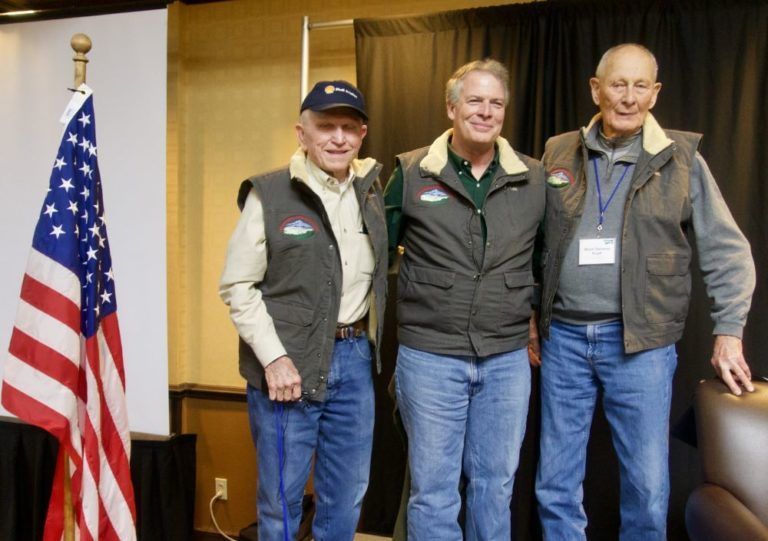
If you were fortunate, you’d have had the chance to meet Frank Borman out at a small airport. Maybe he’d just landed after a bird’s eye view of his ranch near Bighorn, Montana with his son Fred. Frank’s fascination with aviation never wavered, and after his stellar career as an astronaut and airline executive, he owned a series of interesting GA aircraft, and kept flying into his 90s, eventually counting on the convenience of those big Cessna Cardinal doors to access his flight deck.
Mr. Borman passed on November 7 in Billings at the age of 95 after a career in the skies taking him around the Moon. The RAF knew Frank as a fellow pilot, supporter, and friend. We’re told that more than one RAF supporter now proudly flies aircraft formerly owned by Mr. Borman.
Like many aviators, Borman’s fascination with flying began in his teens. He and his father assembled model airplanes. By age 15, Frank was taking flying lessons that he paid for by working after school. He solo’d after only eight hours of dual. He tells of his beginnings in Countdown: An Autobiography, that modestly covers his remarkable life. “Anyone who had the honor to sit and talk with Frank about aviation and space flight realized why NASA leadership handpicked him to guide our nation’s race to the moon, and command the most ambitious mission of manned space flight ever attempted,” RAF Director Pete Bunce said. Bunce had the honor to moderate a conversation during a Montana Aviation Conference in Billings, and has fond memories of Frank.
A true citizen of the Solar System, Mr. Borman attended West Point, then married Susan Bugbee, his high school sweetheart. He became a U.S. Air Force fighter pilot, and instructor at West Point. In 1956, he moved his family to Pasadena, CA, and earned a master’s degree in aeronautical engineering. In 1962, he was one of nine test pilots chosen by NASA for the astronaut program in the new space race against the Soviets.
Borman is best known for his leadership role in the 1968 Apollo 8 mission that circled the moon. His crew included James Lovell and William Anders. Launched from Cape Canaveral on Dec. 21, the trio spent three days traveling before slipping into lunar orbit on Christmas Eve. Astronaut Anders snapped the iconic “Earthrise” photo on one of their ten orbits. Frank wrote, “We were the first humans to see the world in its majestic totality, an intensely emotional experience for each of us. I was sure our thoughts were identical — of our families on that spinning globe. And maybe we shared another thought I had, ‘This must be what God sees.’ ”
After NASA, Borman joined Eastern Airlines, becoming president and CEO. Alerted by a midnight telephone call that a Lockheed Tri-Star had gone down in the Everglades, Borman chartered a helicopter and landed on a patch of grass in the swamp to coordinate rescue efforts. He accompanied three survivors on the helicopter to a hospital.
Bormans moved to Las Cruces, NM after his Eastern career. But their final home was in Big Sky County, where Frank could enjoy just going aloft in his jeans and flannel shirt whenever he wanted. “Even in his senior years, Frank’s keen flying abilities, pride in his meticulously maintained aircraft, his quick wit and phenomenal memory – demonstrated by reciting the complex sequence of re-entry parameters for the command module – put all aviators surrounding him in total awe. Frank was a patriotic leader who excelled as a test pilot, astronaut, and airline CEO,” Bunce said.
Susan passed away in 2021. At Frank’s passing, NASA Administrator Bill Nelson said, “[Frank’s] lifelong love for aviation and exploration was only surpassed by his love for his wife Susan.”
Bunce reflects, “For those of us fortunate enough to have known him, and old enough to remember being glued to the TV on Christmas Eve, 1968, listening to him read from the book of Genesis and watching the first broadcast of an earth rise, savor the memory of being in presence of one of the greatest aviators of all time.”
Submitted November 29, 2023
By Carmine Mowbray
Recent Posts