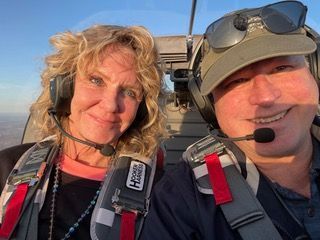
Dave Schuler

Dave Schuler of Apgar, Montana, lives very near Glacier National Park’s West entrance, and within six miles of the RAF’s Ryan Field. He and his wife Cindy are some of the few folks who call it home year round, as it gets pretty quiet when the Park closes for the season and heavy snows blanket the forest.

“I discovered the RAF at AOPA’s Missoula fly-in,” he said. When he and Cindy built their home on family land in Apgar, near Ryan Field, “I reached out to see if they might need occasional assistance. Little did I know if you raise your hand around this outfit, be prepared to have someone grab it, give it a hearty shake and hand you a shovel,” he says. Dave has volunteered to be the local go-to guy if something needs to be done on the Ryan property, a great deal of help for the RAF.


Dave otherwise manages his profession, overseeing field operations for the largest crop insurer in the U.S. and Canada. “We insure everything from corn to clams, cows to citrus,” he says.


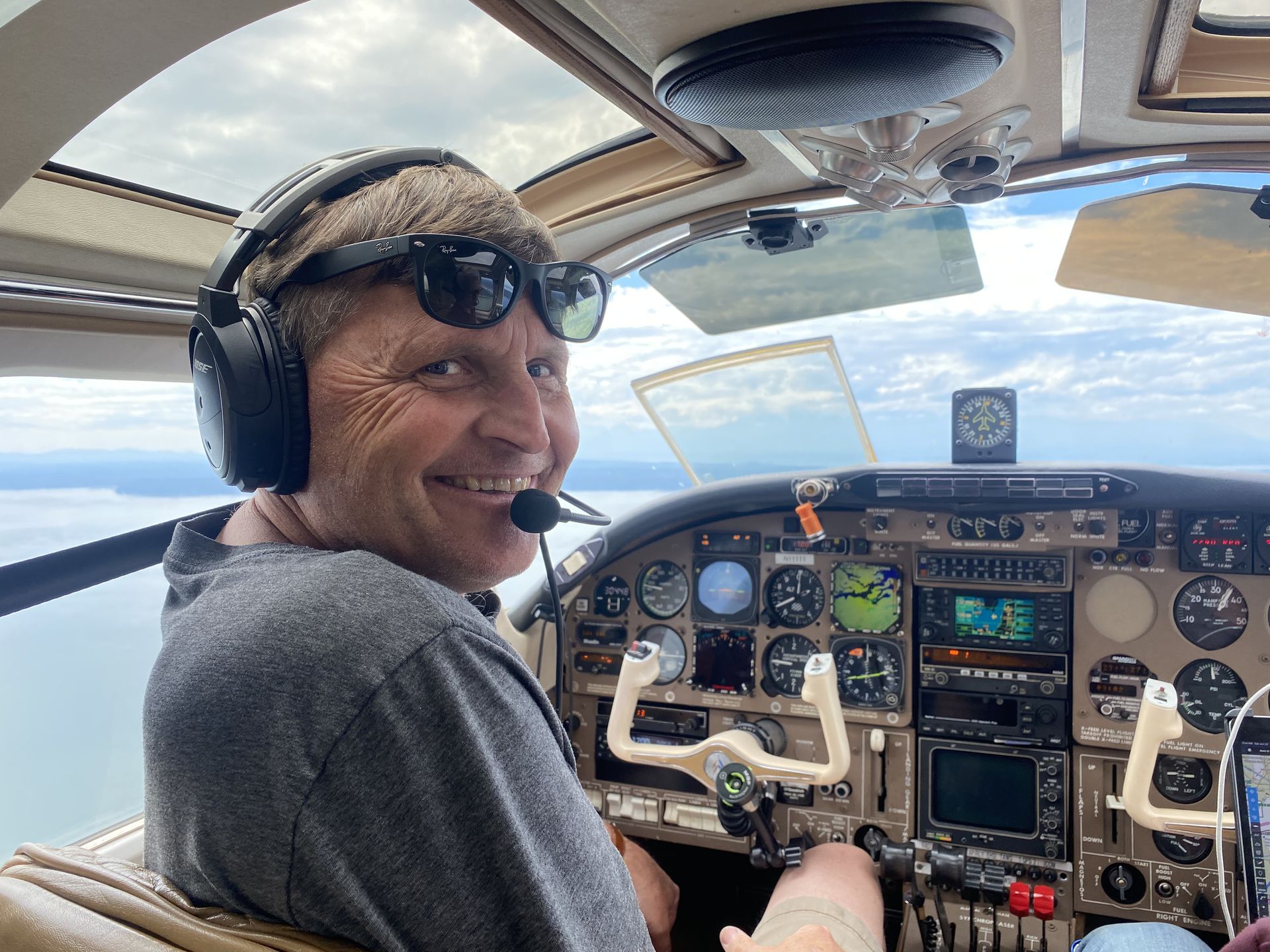
Dave grew up on a grain farm north of Great Falls. He was exposed to flying by his father who was a crew chief for the Montana National Guard, and involved in the CAP. Dave took his first flight lesson from a local spray pilot in October of 1973. He learned to fly from a North-South grass airstrip just off the notoriously windy east slope of the Rocky Mountain Front, and logged hours in and out of the small airports of Conrad, Fairfield, Dutton and Choteau. The Great Falls Tribune reported that Montana's highest recorded wind gust came in 2002 at 143 mph near Choteau. ”I developed good crosswind skills,” Dave says. He solo’d before he turned 16, so the instructor had to “post-date” his logbook entry. 


“I added my commercial, instrument, CFI, and AI credentials at Sunbird Aviation in Bozeman while attending Montana State University.” Upon returning from Bozeman, he started a flight school with two Cessna 150s based out of Choteau. “I used one 150 as a Jeep,” he quips.


A grain buyer who had gotten into the insurance business invited Dave to “get an airplane and we’ll go visit agents,” and Dave’s career literally took off, first in a Cessna 210, then a Beech Baron. One year, Dave recalls he was “271 day days straight on the road.” Over the past 40-plus years, he’s flown into or over 49 of the 50 states, and four Canadian provinces with stays in Barrow, Deadhorse, Prudhoe Bay, and Nome, in Alaska (and twice flew around Denali in VFR), Churchill, Manitoba; Yellowknife, Northwest Territories; and Rankin Inlet in Nunavut, and points in between.


He came to a decision when his son was born, “Did I want to be a nomad or a father,” and he stepped out of aviation for 20 years. 


A backcountry seminar re-ignited his passion for flying, and he got current, and between 2015 and 2017 completed a Vans 14 – it only took him two years to complete the aircraft, and its 20,500 rivets. “I’m a typical farmer, I have a tool hobby. Good thing I don’t live too close to a tool warehouse,” he says. Dave flew his homebuilt to Oshkosh, and it earned him a Bronze Lindy at AirVenture. 


Having accumulated around 4,000 hours so far, Dave and Cindy enjoy their RV-14 and use it for pleasure trips. Their son works in Missoula, and their daughter is an attorney for the State of Montana in Helena.


Facing eventual retirement, Dave had wondered how he could build a new community. It seems he’s found it. “The folks I’ve met through the RAF are all fantastic. It’s a unique collection of folks, all with passion for saving these airfields,” he says.


Submitted February 12, 2025
By Carmine Mowbray


Posted in News

Recent Posts
By Kodi Myhre December 23, 2025
At about this time, every year, we have this conversation at the RAF about what our year end letter (code for asking for your financial support) should say to you, and about the RAF and the accomplishments of the past year.
By Taylin Trafton December 23, 2025
Our many RAF supporters have such vast and varied experience, and we’re capturing some of their words of wisdom to share with you. This guest editorial is by Stef Goza, a pilot and an RAF Alaska liaison.
By lellington December 21, 2025
Bill credits aviation for much of his success in business and the ability to serve his companies and family. What began in a Champ, and a Tri-Pacer owned by five people, turned into what Bill calls, “a key business tool” in which he accumulated 9,000 hours – in a Cheyenne, a Pilatus, and a TBM, where ninety-five percent of his flying was for business. “My retirement enabled me to recall ‘Why I Learned to Fly’, a slogan from an old RAF video.” Bill’s son, Patrick, purchased the C185 they now share. “While attending a business function, some associates arrived in corporate jets. As they joined up on the tarmac, the jet pilots gathered around Patrick’s 185, and one of the passengers asked, ‘What’s special about this?’ No explanation needed for this RAF audience,” Bill says. “My involvement in the RAF is, in a partial way, repaying the rewards aviation has endowed me with. Having been involved in many worthwhile nonprofits, this is one where financial support is only part of the picture. Physically participating in great projects that have a lasting effect, with good people, returns a great personal benefit,” he says. “My only regret is that I wasn’t there at the start.” Bill and his wife Jane are privileged to be able to split time between their long-time home in eastern Nebraska and Scottsdale, Arizona. While still serving on several boards, he enjoys golf “about every third shot,” biking, cars, and reading, but always looks forward to the time he can be involved in the RAF. “It’s flying with a purpose,” he adds. Bill can be reached at bdugan@theraf.org
December 15, 2025
AR Ambassador
By Taylin Trafton December 11, 2025
A Christmas gift of flight lessons from his parents started Scott Anttila’s aviation journey in 1985. “I learned at Johnson Field, a small grass strip tucked into the woods in Michigan’s Upper Peninsula, and that early exposure to simple backcountry flying stuck with me,” Scott says. Growing up in the U.P., he spent a lot of time outdoors and found that flying was another way to get to the places he liked to explore—especially the ones most people never saw. As he earned more ratings and eventually moved to the Detroit area for work, Scott realized he needed a way to stay connected to northern Michigan. He bought an airplane and used it to get back to the smaller airstrips and lake country he enjoyed. Along the way, he also flew gliders out of Frankfort, soaring along the Sleeping Bear Dunes and towing sailplanes over the Great Lakes. “Those flights gave me a different appreciation for the landscape and made me even more interested in the small, out-of-the-way airports scattered around the state,” he says. Visiting those kinds of places, Scott first came across the Recreational Aviation Foundation. He started using RAF-supported airstrips both inside and outside Michigan. “I noticed how well-kept they were and how much access they opened up,” he says, adding, ”Over the years, I’ve watched a number of grass strips close, which made the RAF’s mission feel especially important to me. Maintaining these airstrips keeps aviation connected to the outdoors and makes it possible for more people to reach the quiet, remote areas that inspired me to fly in the first place.” Scott joins the other two RAF Michigan Liaisons, General Grant and Tanmoy Ganguly. He can be reached at santtila@theraf.org . Submitted December 11, 2025.