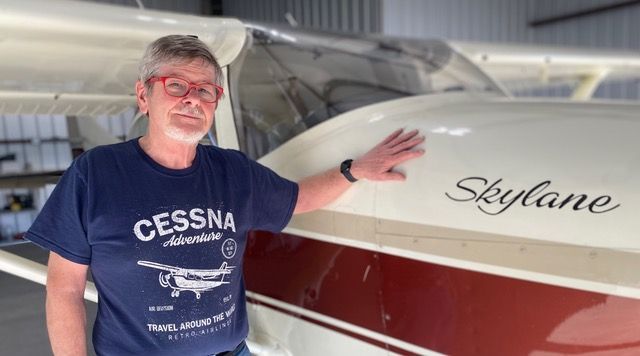
Bob Martin

Three things stand out among RAF supporter Bob Martin’s passions: aviation, his devotion to Havana Regional Airport, and the newspapers his family started in 1855. Bob is the fourth continuous generation to publish these Illinois community newspapers.

Very few people can talk about how their family members were contemporaries of Abraham Lincoln long before he became the 16th President. “My great-great uncle published the Fulton Democrat, so the newspaper had to endorse Stephen Douglas, even though my family knew Mr. Lincoln, and knew he was a good guy,” Bob says.


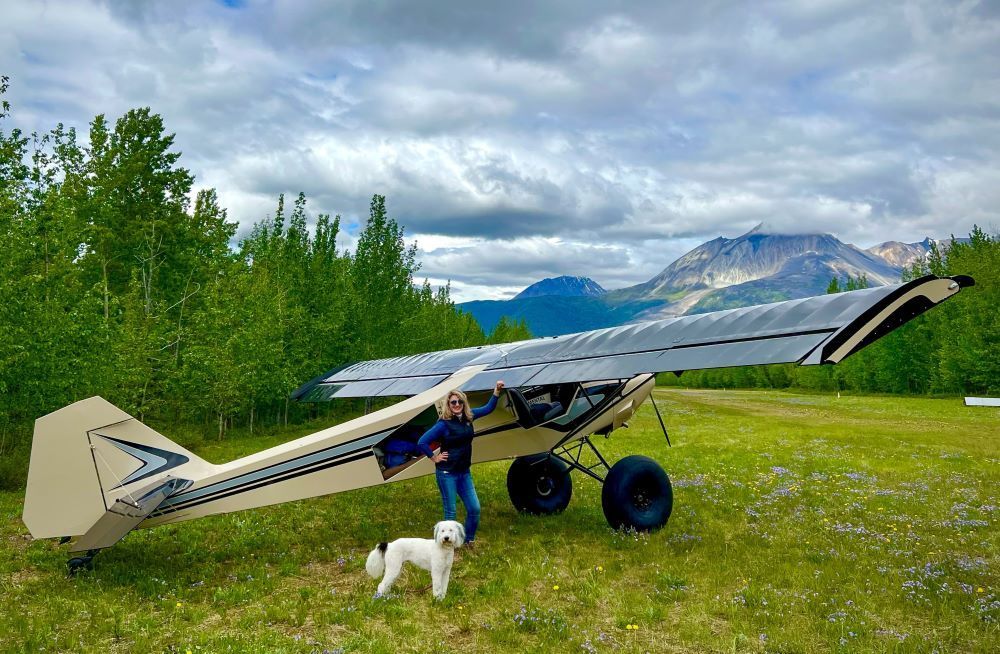
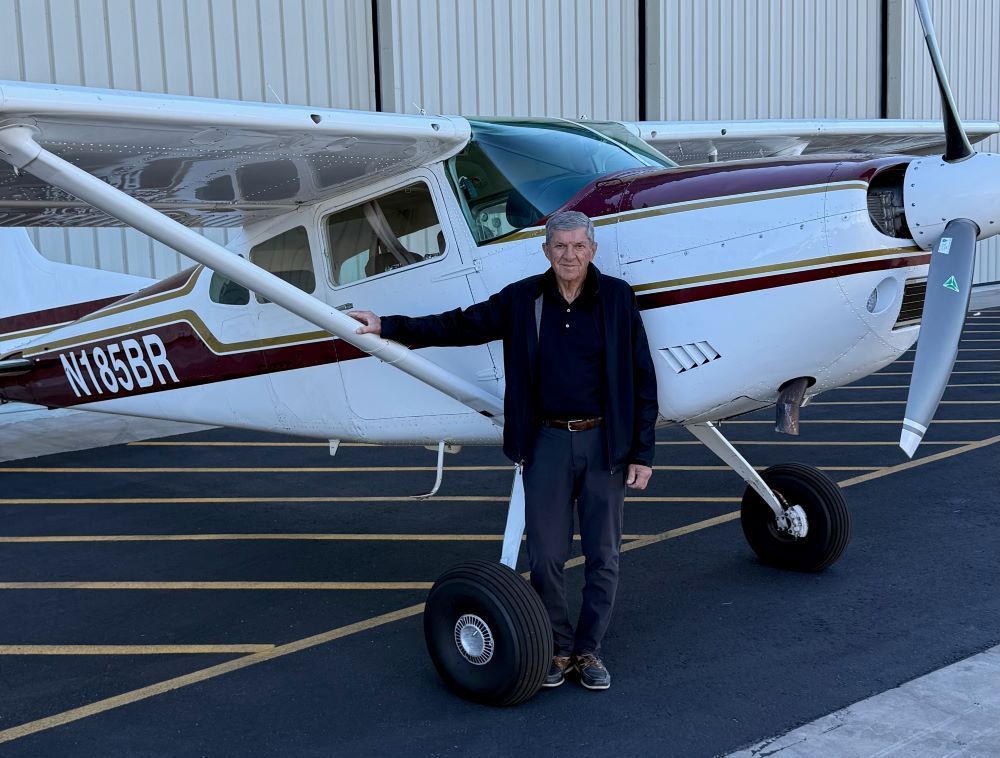
Bob’s personal email is CessnaBob, and his “daily driver” is a STOL 182H that he flies out of Havana about 80 hours each year. He and his wife Wendy enjoy flying into turf strips for recreation. “Here at Havana, we’re in the middle of nowhere, far from anywhere, so we’re ‘backcountry’ too, including a grass strip,” Bob says. With that spirit, Bob, as a director on Havana’s Port Authority board, has helped improve the airport for recreational opportunities. 


“When we told him how some visitors flew in to camp just to appreciate the dark night skies here, Mike came up with the idea of doing an Astronomy Night. That has been hugely popular with the community,” Bob says.


“The RAF actually has played a big part in the direction the airport has taken in recent years,” Bob says. It was seeing the airport through the eyes of RAF Illinois Liaison Mike Purpura that opened their eyes to ways both the Airport Board and local EAA Chapter 1420 could promote the airport near and far.


Purpura is also credited for suggesting the development of a Migratory Bird Fly-In that attracted more than two-dozen visitors from four states just this past March.
Bob and other volunteers from EAA Chapter 1420 were able to use an RAF grant to construct a picnic pavilion that complements their appealing terminal, with conference room, kitchen, restrooms, and showers. The airport has a camping and picnic area with fire ring. Bob is especially proud of the expanding stand of hardwood trees the group has planted to create a shady grove for the picnic area. 


One of the most unusual features of Bob’s home airport is the observation tower one of the EAA members constructed. “He’s a talented contractor. He built an observation tower on the ground, and used a crane to hoist it into position. All the materials and labor were donated,” he added.


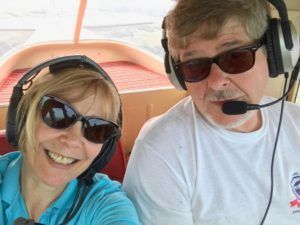
Being self-employed, Bob says he can choose his time to serve the airport’s needs, maintaining the facilities, mowing, and a doing lot of State and FAA clerical work. His spare time is limited, and as an EAA aircraft builder, he’s in the middle of building a Van’s RV 7-A. “I’m in the tenth year of a two-year project,” he jokes. Wendy is editor of the papers, and has won awards for investigative journalism, and also served as president of the Illinois Press Association. “She’s my co-pilot in business, and when we fly,” Bob says. “I couldn’t do this without her.” Martins have grown children and grandchildren who also enjoy flying.

“I have appreciation for the network of people in the RAF who are developing strips throughout the country – rehabbing them, make them available for public use, which is great,” he says, and he and Purpura are turning their attention to a couple of abandoned Illinois airfields with hopes to restore them to safe use for recreational access.

EAA volunteers host cookouts and pancake breakfasts, in addition to fly-in events. The flying public is certainly the beneficiary of Bob’s energy and connections, and can now enjoy many amenities and feel welcome at this place “far from anywhere.”


Submitted on April 14, 2023.

Recent Posts
By Kodi Myhre December 23, 2025
At about this time, every year, we have this conversation at the RAF about what our year end letter (code for asking for your financial support) should say to you, and about the RAF and the accomplishments of the past year.
By Taylin Trafton December 23, 2025
Our many RAF supporters have such vast and varied experience, and we’re capturing some of their words of wisdom to share with you. This guest editorial is by Stef Goza, a pilot and an RAF Alaska liaison.
By lellington December 21, 2025
Bill credits aviation for much of his success in business and the ability to serve his companies and family. What began in a Champ, and a Tri-Pacer owned by five people, turned into what Bill calls, “a key business tool” in which he accumulated 9,000 hours – in a Cheyenne, a Pilatus, and a TBM, where ninety-five percent of his flying was for business. “My retirement enabled me to recall ‘Why I Learned to Fly’, a slogan from an old RAF video.” Bill’s son, Patrick, purchased the C185 they now share. “While attending a business function, some associates arrived in corporate jets. As they joined up on the tarmac, the jet pilots gathered around Patrick’s 185, and one of the passengers asked, ‘What’s special about this?’ No explanation needed for this RAF audience,” Bill says. “My involvement in the RAF is, in a partial way, repaying the rewards aviation has endowed me with. Having been involved in many worthwhile nonprofits, this is one where financial support is only part of the picture. Physically participating in great projects that have a lasting effect, with good people, returns a great personal benefit,” he says. “My only regret is that I wasn’t there at the start.” Bill and his wife Jane are privileged to be able to split time between their long-time home in eastern Nebraska and Scottsdale, Arizona. While still serving on several boards, he enjoys golf “about every third shot,” biking, cars, and reading, but always looks forward to the time he can be involved in the RAF. “It’s flying with a purpose,” he adds. Bill can be reached at bdugan@theraf.org
December 15, 2025
AR Ambassador
By Taylin Trafton December 11, 2025
A Christmas gift of flight lessons from his parents started Scott Anttila’s aviation journey in 1985. “I learned at Johnson Field, a small grass strip tucked into the woods in Michigan’s Upper Peninsula, and that early exposure to simple backcountry flying stuck with me,” Scott says. Growing up in the U.P., he spent a lot of time outdoors and found that flying was another way to get to the places he liked to explore—especially the ones most people never saw. As he earned more ratings and eventually moved to the Detroit area for work, Scott realized he needed a way to stay connected to northern Michigan. He bought an airplane and used it to get back to the smaller airstrips and lake country he enjoyed. Along the way, he also flew gliders out of Frankfort, soaring along the Sleeping Bear Dunes and towing sailplanes over the Great Lakes. “Those flights gave me a different appreciation for the landscape and made me even more interested in the small, out-of-the-way airports scattered around the state,” he says. Visiting those kinds of places, Scott first came across the Recreational Aviation Foundation. He started using RAF-supported airstrips both inside and outside Michigan. “I noticed how well-kept they were and how much access they opened up,” he says, adding, ”Over the years, I’ve watched a number of grass strips close, which made the RAF’s mission feel especially important to me. Maintaining these airstrips keeps aviation connected to the outdoors and makes it possible for more people to reach the quiet, remote areas that inspired me to fly in the first place.” Scott joins the other two RAF Michigan Liaisons, General Grant and Tanmoy Ganguly. He can be reached at santtila@theraf.org . Submitted December 11, 2025.